

At this point in this series of blogs about God’s promise to bring our Savior into the world, we have completed a brief overview of the Ten Commandments, given to the covenant people through God’s chosen leader, Moses. The Israelites have heartily agreed to God’s plan to be a “holy” nation, His selected people to bring a blessing to the whole world. What happens next?
Beginning with Exodus 21 and extending through chapter 31, God gives His people instructions in three areas. Chapters 21-23 are a kind of “fleshing out” of some of the commandments, what to do in specific situations, etc. In Exodus 24-27, Moses seals the covenant between God and the Israelites with blood and goes up into the Mountain, where he spends forty days with God.
There with God on the mountain, Moses receives God’s blueprint for the tabernacle, the portable structure where the Israelites will worship. Exodus 26-27. The last portion of these chapters, Exodus 28-31, covers the ordination of Aaron and his sons into the priesthood, their robes and headgear, and the special ephod for Aaron, the high priest. Instructions are given for altars for incense and burnt offerings, the preparation and procedures for offerings, and the designation of Bezalel as the craftsman to build the special equipment for worship. This section of Exodus ends with God telling Moses to tell the people they are to strictly observe the Sabbath as a sign of their covenant with Him.
The last verse of Exodus 31 reads, “And when He had finished speaking with him upon Mount Sinai, He gave Moses the two tablets of the testimony, tablets of stone, written by the finger of God.”
As you can see, God has gone to great lengths to prepare the chosen people to be a holy nation and carry His promise to bless all nations of the earth. But something tragic happens while Moses is on the mountain for forty days with God.
God’s goodness and faithfulness are “rewarded” with deliberate rebellion. Here’s how the Israelites reacted to Moses’ forty-day absence:
“Now, when the people saw that Moses delayed in coming down from the mountain, the people assembled about Aaron and said to him, ‘ Come, make us a god who will go before us; as for this Moses, the man who brought us up from the land of Egypt, we do not know what has become of him.'” Exodus 32:1
I have three questions I want to explore with you about this disappointing action of the Israelites: What did they do? Why did they do it? How did God and Moses respond to this tragedy?
Today, we will attempt to answer the first question: What did the Israelites do?
About forty days before the incident recorded in Exodus 32:1, the Israelites agreed to do all that the Lord told them. They had gladly accepted the Ten Commandments as the rules by which they would live, which included ” you shall have no other god before me” and “you shall not make for yourselves an idol.”
What “the people” demanded Aaron to do was clearly a violation, a sin, breaking the covenant law to which they had already agreed. They were replacing God with an idol.
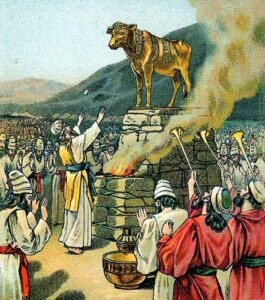
Exodus 32:2-6 provides details on how Aaron gave in to their demands, conspiring with the people to commit idolatry. There is no indication that Aaron did anything to resist their demand, but he took gold earrings from the people, melted them, and fashioned a gold calf. Exodus 32: 4 concludes with this declaration, ” And they said, this is your god, O Israel, who brought you up from the land of Egypt.”
After this, Aaron built an altar before the idol and declared a celebratory feast for the next day. “So the next day they arose early and offered burnt offerings, and brought peace offerings; and the people sat down to eat and to drink, and rose to play.” Exodus 32:6.
The Israelites have clearly and deliberately committed idolatry by their actions. Below is a picture of what the idol may have looked like. Exodus 32:4 reads that, someone (unidentified) said to the Israelites, “This is your god, O Israel, who brought you up out of the land of Egypt.”
The commandment related to idolatry found in Exodus 20: 4-5a reads: “You shall not make for yourself an idol, or any likeness of what is in heaven above or on earth beneath or in the water under the earth. You shall not worship them or serve them.”
What are those who proposed the idol doing? They are deceiving the people with the lie that this gold calf, fashioned by a man, is the source of their freedom, their safe passage through the sea, their provision in the wilderness, and the author of the Ten Commandments. So, what is idolatry?
Think about this. God is the Source of all good that comes to us. To credit what He does to something or someone else is to make that thing or person an idol. James 1:17 says this: “Every good thing bestowed and every perfect gift is from above, coming down from the Father of lights, with whom there is no variation or shifting shadow.”
Here’s one of many applications of how we can understaand idolatry. Those who contribute to our well-being are instruments, used by our great God for our good. While we should respect and appreciate those who help us, we need to recognize that, ultimately, our help comes from the Lord. So, we should not, no matter how wonderful that person may be, put him or her in God’s rightful place. To do so is idolatry. The Israelites were being told to give the golden calf the credit for what God had done for them.
For the Israelites, idolatry related to putting their trust and faith in a physical object. But the reality is that we commit idolatry anytime we place our ultimate trust and security in anything or person other than God: money, property, relationships, health, power, or fame.
In the next blog, we will attempt to understand why the Israelites did what they did. If my blogs are helpful to you, please invite family and friends to sign up for them at http://www.cosdavis.com